
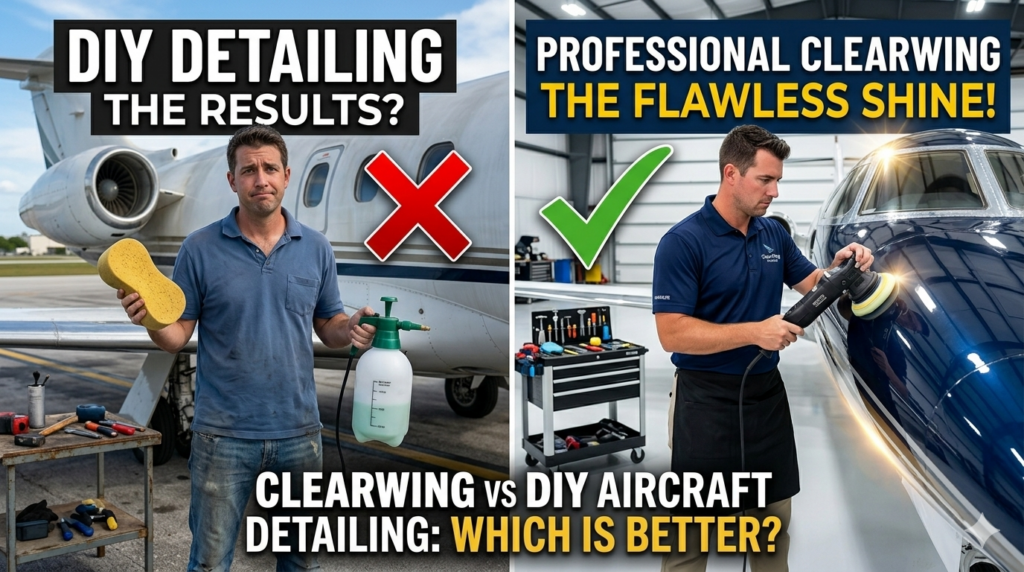
If you own a piston single or light twin and you’ve always washed your own aircraft, you know the satisfaction of a clean airplane you prepared yourself. But as aircraft get more complex — more surface area, more sensitive materials, more to get wrong — the calculus shifts. This article offers an honest comparison of DIY aircraft detailing versus hiring a professional mobile service like ClearWing, so you can make the right decision for your aircraft and your time.
What DIY Aircraft Detailing Actually Involves
A proper DIY aircraft detail isn’t a 20-minute garden hose session. Done right, it involves:
- Acquiring appropriate aviation-safe cleaning products (not automotive, not household)
- Proper rinse-less wash technique to avoid creating runoff compliance issues at the airport
- Physical access to all surfaces — this means ladders, step stools, and working around control surfaces
- Understanding what not to spray near (pitot tubes, static ports, avionics vents, fuel caps)
- Interior cleaning with appropriate material-specific products
- Significant time — typically 3–6 hours for a thorough clean on a light aircraft
The Hidden Costs of DIY
The economic argument for DIY usually focuses on product cost vs. service cost. But there are several hidden costs that change the calculation:
Your time: If your hourly professional rate is $100–$500/hour, spending 5 hours washing your aircraft costs significantly more in opportunity cost than a professional detail service. This is especially true for business owners and professionals who could be billing client hours.
Product investment: Aviation-safe cleaning products, a quality buffer, microfiber towels, extraction equipment, and proper leather conditioner represent a significant initial and recurring cost. A professional amortizes this across dozens of aircraft.
Risk of damage: Using the wrong product on an aircraft surface — or the right product incorrectly — can cause damage that costs more to repair than the detail would have cost. Scratched windows, damaged leather, stripped brightwork, and contaminated avionics vents are all real risks of uninformed DIY work.
Airport access and compliance: Water runoff from aircraft washing is regulated at many Florida airports. Improper washing that creates hangar runoff can result in FBO fees or violations. Professional mobile detailers use rinse-less wash systems specifically because they’re ramp-compliant.
Where DIY Still Makes Sense
There are scenarios where DIY is genuinely appropriate:
- Between-detail maintenance washes on a piston single you own outright and know intimately
- Quick interior touch-up after a messy flight — wiping surfaces and vacuuming before a professional detail
- If you’re an A&P mechanic or aviation professional with detailed product knowledge
- Aircraft stored long-term where you’re doing periodic light cleaning while the aircraft isn’t in service
Where Professional Detailing Is the Clear Choice
- Any turbine aircraft (jets, turboprops) — complexity and value justify professional care
- Charter aircraft that must present a premium cabin experience for paying passengers
- Aircraft with existing oxidation, staining, or damage that requires professional correction techniques
- Before any aircraft sale, appraisal, or major inspection
- When you want to apply ceramic coating — this requires certified professional installation
- When time is the primary constraint — a professional team finishes in the time it would take you to set up
The Recurring Program Advantage
One option many aircraft owners overlook is a recurring professional detail program. At ClearWing, we offer regular scheduled service — monthly, quarterly, or custom intervals — at airports across Central Florida. A recurring program means:
- Your aircraft is always presentation-ready without planning effort
- Issues are caught early (staining, oxidation, leather cracking) before they become expensive
- You qualify for program pricing that’s more economical than one-off service rates
- Documentation builds a complete, timestamped maintenance record
The math often works out clearly: a recurring monthly detail at professional rates costs far less than the occasional major restoration detail required when maintenance has been neglected for 12–18 months.
Verdict
For light piston aircraft you personally maintain and have deep familiarity with, DIY between professional services is a reasonable approach. For anything more complex — and for anyone who values their time — professional mobile aircraft detailing is the smarter choice on every dimension: quality, safety, compliance, and total cost of ownership.
| Ready to Hand It Off to the Professionals? |
| ClearWing Aviation Detailing comes to your airport across all of Central Florida. Certified, insured, and experienced on jets and turboprops — we make aircraft care effortless. Call (321) 375-2200 or email clearwingaviationdetailing@gmail.com to get started. Ask about our recurring detail programs. |